
Content Management Best Practices: Organize and Retrieve Online Resources

Most professionals still believe content management is just file storage, but the reality is much more advanced. With american organizations handling thousands of resources daily, clutter and confusion can stall productivity. Recent studies show that effective content systems improve retrieval speed by over 50 percent. This guide uncovers essential strategies and clears up myths, helping you create efficient processes for saving, organizing, and finding every piece of content you need.
Table of Contents
- Content Management Fundamentals And Myths
- Categories Of Saved Content And Formats
- Setting Up An Efficient Content System
- Leveraging Ai For Search And Discovery
- Privacy, Compliance, And Common Pitfalls
Key Takeaways
| Point | Details |
|---|---|
| Strategic Nature of Content Management | Content management transcends technical processes, requiring a strategic approach that integrates creation, organization, governance, and retrieval to meet organizational goals. |
| Importance of Categorization | Effective content management involves categorizing resources by type and context, necessitating specific strategies for diverse formats to ensure efficient access and preservation. |
| Leveraging AI for Enhanced Search | AI technologies significantly improve search capabilities by offering contextual understanding and adaptive recommendations, which streamline user interactions and enhance retrieval efficiency. |
| Focus on Compliance and Privacy | Organizations must develop robust content governance frameworks to address privacy regulations, ensuring data protection while enabling effective content management and collaboration. |
Content Management Fundamentals and Myths
Content management has rapidly transformed from a simple filing system to a complex digital ecosystem driven by technological innovations. Contemporary content studies reveal that modern content management goes far beyond basic storage and retrieval—it’s about creating meaningful, contextual information ecosystems that adapt to changing organizational needs.
Many professionals misunderstand content management as a purely technical process. However, the reality is much more nuanced. Content management is a strategic discipline that involves multiple interconnected processes: creation, organization, governance, storage, and intelligent retrieval. Professional training programs emphasize that effective content management requires understanding not just tools, but also organizational goals, workflow dynamics, and human interaction patterns.
Key myths about content management persist despite technological advancements. Contrary to popular belief, content management is not about accumulating massive amounts of data, but about curating high-quality, relevant information. It’s a dynamic process that requires ongoing curation, context-aware organization, and strategic thinking. Successful content management demands a holistic approach that balances technological capabilities with human insight.
Pro Tip: Develop a consistent tagging and categorization system that allows flexible searching and makes retrieving specific content intuitive and quick.
Categories of Saved Content and Formats
Content saving involves managing a diverse array of digital and physical resources across multiple formats and categories. Academic research highlights the complexity of content categorization, which goes beyond simple file types to encompass context, purpose, and informational value.
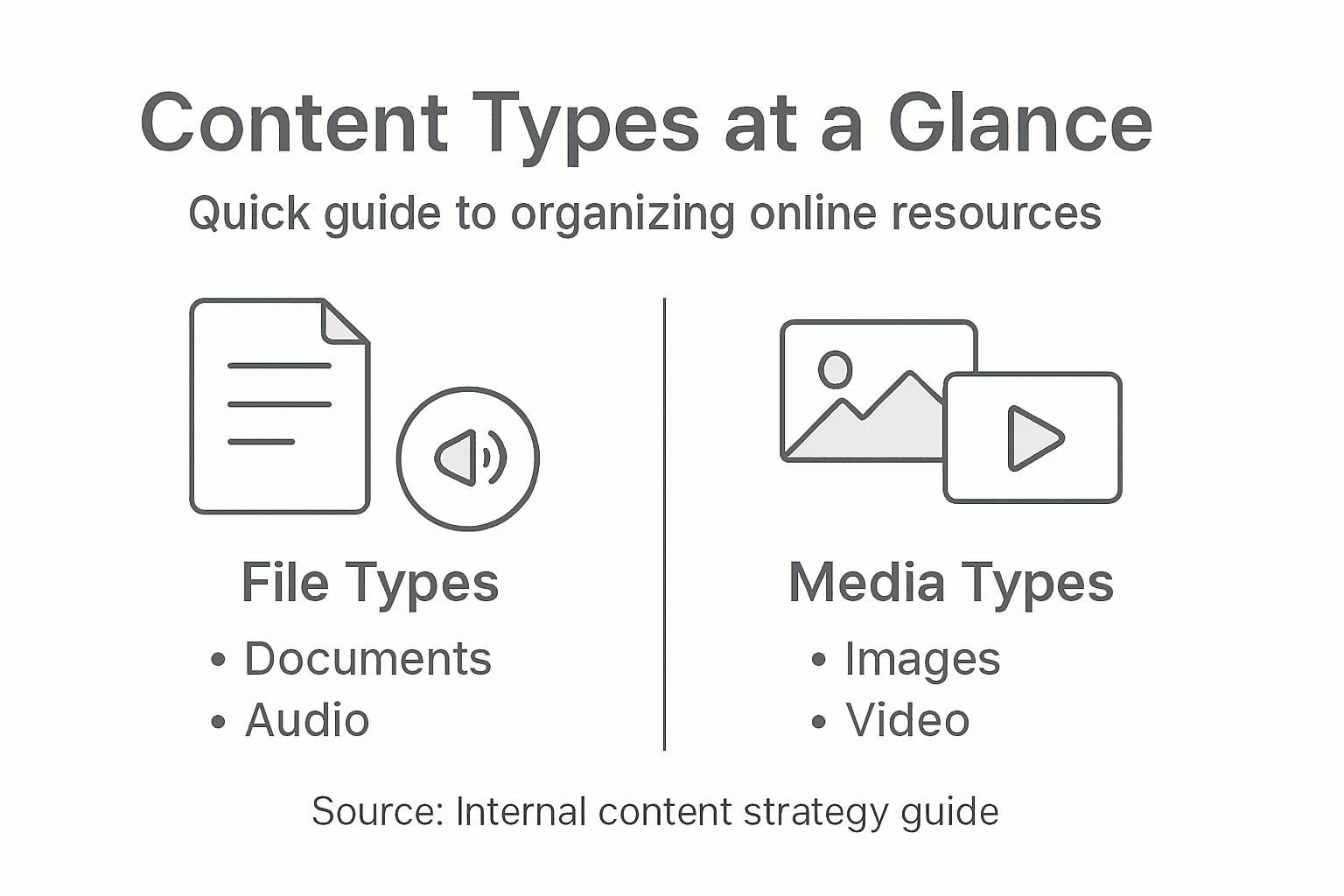
Content categories can be broadly classified into several key types: textual resources, visual media, audio recordings, and multimedia compositions. Source classification methods typically distinguish between primary sources (original materials), secondary sources (interpretative content), and tertiary sources (summative references). Each category requires specific management strategies to ensure efficient retrieval and preservation.

The digital landscape has dramatically expanded content format possibilities. Modern content now includes traditional documents like PDFs and word processing files, alongside more dynamic formats such as web pages, social media posts, podcasts, video recordings, infographics, spreadsheets, presentation slides, and interactive digital content. Effective content management demands flexible systems that can handle this increasingly complex and interconnected ecosystem of information.
Here’s a summary of common content categories and their management needs:
| Category | Example Formats | Management Focus |
|---|---|---|
| Textual Resources | PDFs, Word docs | Version control, tagging |
| Visual Media | Images, infographics | Metadata, copyright |
| Audio Recordings | Podcasts, interviews | Transcripts, archiving |
| Multimedia Compositions | Videos, slides | Compression, access Control |
Pro Tip: Create a standardized naming convention for your saved content that includes date, category, and key identifying information to simplify future searching and organization.
Setting Up an Efficient Content System
Best practices for building a high-performing content system require a strategic approach that integrates technology, people, processes, and governance. Successful content management goes beyond simply collecting information—it demands a comprehensive framework that ensures quality, accessibility, and alignment with organizational objectives.
The foundation of an efficient content system involves establishing clear workflows and collaboration mechanisms. Systematic content organization requires defining specific roles, creating standardized processes, and implementing tools that facilitate seamless information capture and retrieval. Professional content organization strategies emphasize the importance of creating structured environments that support team collaboration, enable quick content development, and maintain consistent quality across different projects and teams.
Key components of an effective content system include developing robust metadata frameworks, implementing intelligent tagging mechanisms, establishing clear governance protocols, and creating flexible retrieval strategies. This approach transforms content from passive storage to an active, dynamic resource that can be quickly accessed, repurposed, and leveraged across different organizational contexts. Modern content systems must be adaptable, scalable, and capable of integrating diverse content types while maintaining clear organizational principles.
Pro Tip: Conduct a quarterly content audit to review and optimize your system, identifying outdated materials, improving categorization, and refining search and retrieval mechanisms.
Leveraging AI for Search and Discovery
Artificial intelligence is revolutionizing search and discovery mechanisms across digital information ecosystems, transforming how users interact with and retrieve complex information. Modern AI technologies go beyond traditional keyword matching, employing advanced natural language processing and machine learning algorithms that understand contextual nuances, user intent, and complex semantic relationships.
The core strength of AI-powered search lies in its ability to create intelligent recommendation systems that adapt and personalize results based on individual user behaviors and preferences. Generative AI technologies are reshaping digital interactions by enabling more intuitive, conversational search experiences that anticipate user needs, provide contextually relevant suggestions, and dramatically reduce time spent searching through massive information repositories.
Advanced AI search capabilities include sophisticated features like semantic search, predictive analysis, contextual understanding, and adaptive learning mechanisms. These technologies can analyze complex query patterns, understand nuanced language variations, and deliver precise results by interpreting the underlying intent behind user searches. By integrating machine learning algorithms, AI-driven search systems continuously improve their accuracy, relevance, and speed, creating increasingly intelligent and responsive information retrieval environments.
Compare the strengths of traditional vs. AI-powered search methods:
| Aspect | Traditional Search | AI-Powered Search |
|---|---|---|
| Matching Method | Keyword-based | Contextual, semantic understanding |
| Personalization | Limited or static results | Adaptive recommendations |
| Result Relevance | Depends on keywords | Learns user intent |
| User Experience | Filter and sort manually | Conversational and intuitive |
Pro Tip: Experiment with different AI search prompts and refine your query language to help algorithms understand your specific information needs more precisely.
Privacy, Compliance, and Common Pitfalls
Best practices for implementing content management systems require a comprehensive approach to navigating the complex landscape of data privacy and regulatory compliance. Organizations must develop robust frameworks that protect sensitive information while enabling efficient content management and collaboration.
The global regulatory environment demands meticulous content governance strategies that address multiple dimensions of data protection. Content compliance intersects with critical privacy regulations like GDPR, CCPA, and industry-specific standards, requiring organizations to implement sophisticated mechanisms for data tracking, user consent management, and transparent information handling. Common pitfalls include inadequate metadata management, inconsistent access controls, and failure to establish clear data retention and deletion protocols.
Effective privacy and compliance strategies involve developing comprehensive policies that address user data rights, implement granular access controls, create automated compliance workflows, and maintain detailed audit trails. Organizations must invest in ongoing training, regular system audits, and adaptive technologies that can quickly respond to evolving regulatory requirements. This approach transforms compliance from a potential liability into a strategic advantage that builds user trust and demonstrates organizational responsibility.
Pro Tip: Conduct quarterly privacy impact assessments to proactively identify and mitigate potential compliance risks before they become significant issues.
Organize and Find Your Digital Resources Effortlessly with MemoKee
The article highlights the challenge of managing diverse content types while maintaining efficient organization and speedy retrieval. Many struggle with scattered bookmarks, unclear tagging systems, and the frustration of “where did I save that?” moments. MemoKee addresses these pain points by providing a unified save-and-find hub where you can capture articles, videos, posts, and more in one easily searchable place. By aligning with best practices like intelligent tagging and consistent categorization, MemoKee transforms your saved content into a dynamic personal library that works with your workflow.

Don’t let disorganized digital clutter slow you down. Experience how MemoKee’s intuitive system supports your content management needs, helping you save time and reduce stress. Start building your organized online resource center today at MemoKee and discover a smarter way to store and retrieve everything important to you.
Frequently Asked Questions
What are the key components of an efficient content management system?
An efficient content management system includes robust metadata frameworks, intelligent tagging mechanisms, clear governance protocols, and flexible retrieval strategies to ensure quality and accessibility of information.
How can I categorize different types of content effectively?
Content can be categorized into textual resources, visual media, audio recordings, and multimedia compositions. Each category requires specific management strategies like version control for documents and metadata management for images and videos.
What are some common pitfalls in content management?
Common pitfalls include inadequate metadata management, inconsistent access controls, and failure to establish clear data retention and deletion protocols, which can lead to challenges in compliance and data organization.
How does AI improve search and discovery in content management?
AI improves search and discovery by employing advanced natural language processing and machine learning to provide contextual and semantic understanding of user queries, resulting in more personalized and relevant search results.