
Knowledge Management in 2026: Smarter Content, Less Chaos

More than 65 percent of American and European knowledge workers report struggling with information overload at least once per week. As digital content multiplies across teams and devices, keeping valuable insights organized feels nearly impossible. Modern Knowledge Management offers practical solutions for smarter workflows and secure collaboration, helping you transform scattered data into accessible, strategic resources that power long-term productivity.
Table of Contents
- Defining Knowledge Management in 2026
- Types of Digital Knowledge Assets Today
- How Modern Knowledge Management Systems Work
- AI, Collaboration, and Smart Search Trends
- Risks, Costs, and Common Pitfalls to Avoid
Key Takeaways
| Point | Details |
|---|---|
| Modern KM Embraces Technology | Knowledge Management in 2026 utilizes AI and machine learning to enhance information capture and retrieval, creating a more dynamic knowledge ecosystem. |
| Diverse Digital Knowledge Assets | Organizations leverage a variety of digital knowledge assets that drive innovation, including intellectual property, operational knowledge, and human expertise. |
| Risk Management is Crucial | Effective Knowledge Management requires addressing risks such as employee knowledge loss and data security to maintain organizational performance and intellectual capital. |
| Continuous Learning is Essential | Organizations should invest in ongoing training and development for staff to ensure effective use and improvement of Knowledge Management systems. |
Defining Knowledge Management in 2026
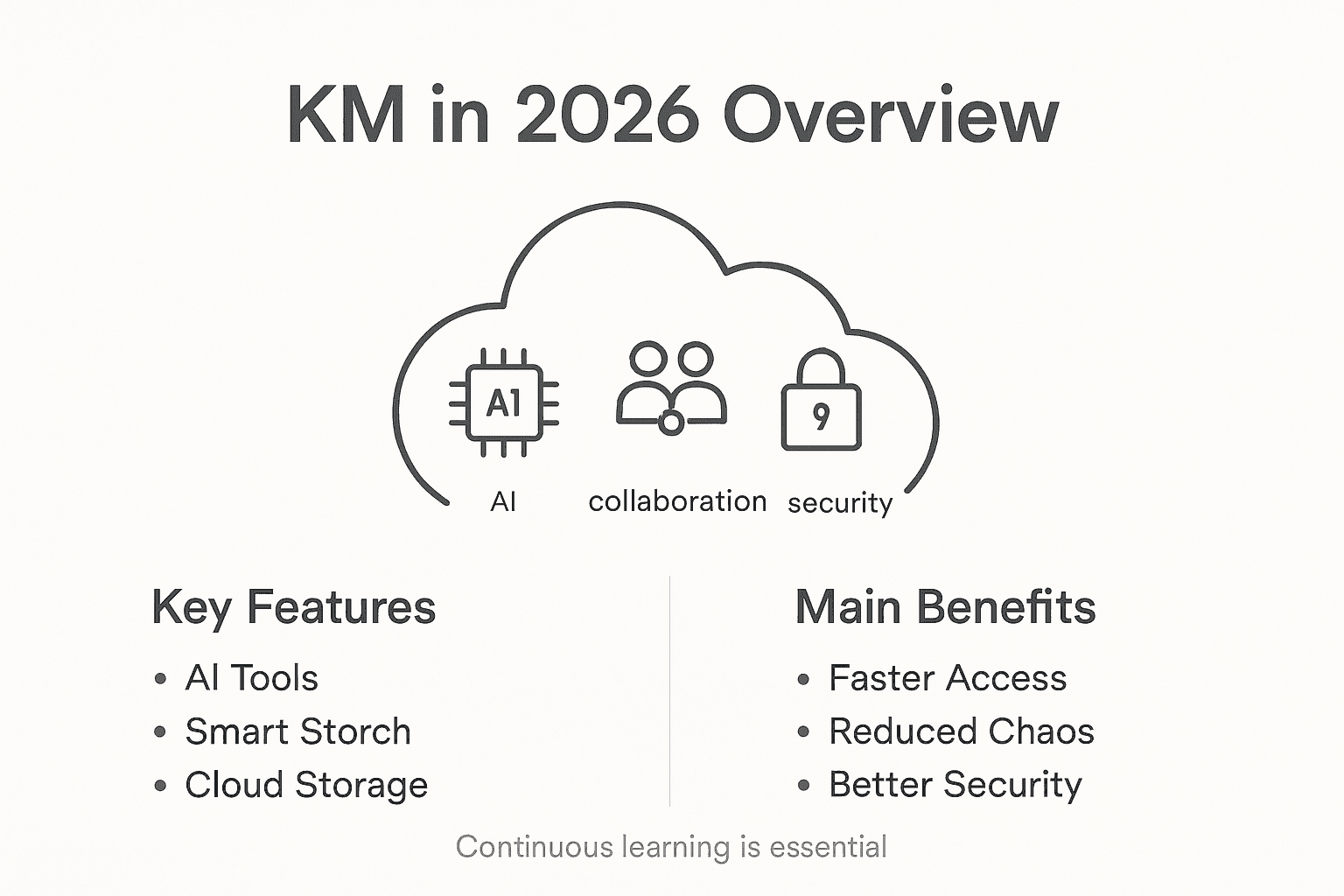
Knowledge Management (KM) in 2026 represents a sophisticated, technology-driven approach to capturing, organizing, and leveraging intellectual assets within organizations. Unlike traditional information storage methods, modern KM integrates advanced technologies like artificial intelligence and machine learning to transform how professionals collect, process, and utilize critical information.
The evolution of Knowledge Management has become increasingly interdisciplinary and complex, drawing contributions from diverse fields including sociology, computer science, economics, and human resource management. This multifaceted approach acknowledges that knowledge is not simply a static resource, but a dynamic ecosystem that requires intelligent navigation and strategic management.
Key characteristics of Knowledge Management in 2026 include:
- Seamless integration of AI-powered search and retrieval technologies
- Real-time collaboration tools that transcend geographical boundaries
- Adaptive systems that learn and improve information categorization
- Enhanced data privacy and secure knowledge sharing protocols
- Personalized knowledge experience tailored to individual work styles
Pro tip: Invest in continuous learning platforms that help you understand emerging KM technologies and develop adaptive information management skills.
Types of Digital Knowledge Assets Today
Digital knowledge assets represent a complex ecosystem of intellectual resources that go far beyond traditional document storage and information management. Modern organizations recognize these assets as strategic tools for innovation and competitive advantage, encompassing a wide range of digital information types that drive organizational performance and decision-making.
These digital knowledge assets can be categorized into several key types, each serving unique organizational purposes. Intellectual property represents one critical category, including patents, research findings, and proprietary methodologies. Operational knowledge assets cover transaction records, process documentation, and systems workflows that capture how work gets accomplished. Human expertise assets include professional profiles, skill databases, and tacit knowledge repositories that capture individual and collective organizational intelligence.
Key types of digital knowledge assets include:
- Explicit documentation (reports, whitepapers, manuals)
- Intellectual property records
- Operational process repositories
- Human expertise profiles
- Transaction and performance data
- Digital collaboration artifacts
- Compliance and governance documentation
Industries prioritize these digital knowledge assets differently. Manufacturing sectors might emphasize operational and logistical resources, while financial institutions focus more on governance and compliance-related digital assets. The strategic value lies not just in collecting these resources, but in creating intelligent, interconnected systems that enable rapid knowledge retrieval and organizational learning.
Here’s a comparative look at how different industries leverage digital knowledge assets:
| Industry | Most Valued Knowledge Assets | Main Strategic Benefit |
|---|---|---|
| Manufacturing | Operational documentation | Process optimization and efficiency |
| Financial Services | Compliance and governance data | Regulatory adherence and risk reduction |
| Technology | Intellectual property & patents | Innovation and market leadership |
| Healthcare | Research findings, best practices | Improved patient outcomes |
Pro tip: Develop a comprehensive digital knowledge mapping strategy that categorizes and cross-references your organization’s intellectual assets for maximum accessibility and strategic value.
How Modern Knowledge Management Systems Work
Modern Knowledge Management (KM) systems represent sophisticated technological ecosystems that integrate multiple interconnected processes for capturing, organizing, and leveraging organizational intelligence. These systems combine advanced technological infrastructure with complex social and cognitive frameworks, enabling seamless knowledge creation, storage, retrieval, and distribution across diverse organizational contexts.

At their core, contemporary KM systems operate through several critical functional components. These include intelligent knowledge acquisition mechanisms that capture both explicit and tacit knowledge, advanced categorization algorithms that intelligently classify and tag information, and dynamic retrieval platforms that enable rapid, context-aware information access. Machine learning and artificial intelligence play pivotal roles in enhancing these systems, allowing for predictive knowledge mapping, automated content recommendation, and intelligent search capabilities that understand user intent beyond simple keyword matching.
Key operational characteristics of modern KM systems include:
- Integrated AI-powered search and recommendation engines
- Real-time collaborative knowledge sharing platforms
- Adaptive learning algorithms that improve information categorization
- Secure, role-based access controls
- Cross-platform knowledge synchronization
- Automated metadata generation and content tagging
- Personalized knowledge discovery interfaces
The technological architecture of these systems typically involves cloud-based infrastructure, advanced data analytics, machine learning models, and sophisticated security protocols. By creating intelligent, interconnected knowledge networks, organizations can transform raw information into strategic assets that drive innovation, improve decision-making, and enhance overall organizational performance.
Pro tip: Implement a continuous learning approach by regularly auditing and updating your knowledge management system’s classification algorithms and search capabilities to maintain maximum relevance and efficiency.
AI, Collaboration, and Smart Search Trends
AI-driven knowledge management technologies are rapidly transforming how organizations capture, organize, and leverage intellectual resources, creating unprecedented opportunities for intelligent information discovery and collaborative workflows. These emerging trends go beyond traditional search mechanisms, integrating sophisticated artificial intelligence capabilities that understand context, predict user needs, and facilitate seamless knowledge sharing across diverse organizational environments.
The core of these technological innovations lies in advanced semantic search technologies and contextual intelligence. Unlike traditional keyword-based searches, modern AI systems can comprehend user intent, interpret complex queries, and deliver hyper-personalized knowledge results. These intelligent systems leverage machine learning algorithms to continuously improve search accuracy, generate intelligent content recommendations, and create dynamic knowledge networks that adapt to evolving organizational information landscapes.
Key trends in AI, collaboration, and smart search include:
- Semantic search replacing traditional keyword matching
- Generative AI-assisted content creation
- Contextual knowledge personalization
- Predictive intelligence for trend detection
- Autonomous AI agents managing knowledge workflows
- Real-time collaborative knowledge sharing platforms
- Dynamic knowledge graph development
The integration of artificial intelligence with collaborative platforms enables unprecedented levels of organizational intelligence. By creating interconnected knowledge ecosystems that transcend traditional information silos, these technologies empower professionals to access, share, and leverage intellectual resources with remarkable speed and precision. The future of knowledge management lies in creating intelligent, adaptive systems that understand human information needs and facilitate seamless knowledge exchange.
Pro tip: Develop a strategic AI integration roadmap that prioritizes contextual understanding and personalization in your knowledge management approach.
Risks, Costs, and Common Pitfalls to Avoid
Knowledge management systems present complex organizational challenges that extend far beyond technological implementation, with significant risks emerging from inadequate planning, poor user adoption, and fundamental misunderstandings about knowledge capture and distribution. Organizations frequently underestimate the human and technological complexities involved in creating effective knowledge ecosystems, leading to substantial financial and operational consequences.
The most critical risks stem from systemic knowledge vulnerabilities that can dramatically impact organizational performance. These vulnerabilities include uncontrolled knowledge loss during employee transitions, ineffective information categorization, inadequate security protocols, and technological infrastructure limitations. Poorly designed knowledge management systems can create information silos, reduce collaboration efficiency, and ultimately compromise an organization’s intellectual capital and competitive positioning.
Key risks and potential pitfalls include:
- Unmanaged employee knowledge transfer during staff turnover
- Inadequate user training and system adoption
- Insufficient data security and access control mechanisms
- Overreliance on technology without human contextual understanding
- Poor metadata and classification strategies
- Lack of continuous system optimization
- Inconsistent knowledge contribution policies
- Technological infrastructure compatibility challenges
Successful knowledge management requires a holistic approach that balances technological capabilities with organizational culture, human behavior, and strategic objectives. By proactively identifying and mitigating potential risks, organizations can create resilient knowledge ecosystems that adapt to changing business environments and protect critical intellectual assets.
This table summarizes major risks in KM systems and strategies for mitigation:
| Major KM Risk | Business Impact | Suggested Mitigation |
|---|---|---|
| Employee knowledge loss | Decreased continuity, lost insights | Succession planning, knowledge transfer tools |
| Poor user training | Low adoption, wasted investment | Comprehensive onboarding, ongoing education |
| Inadequate security | Data breaches, compliance fines | Strong access controls, regular audits |
| Overreliance on automation | Missed context, decision errors | Human review in critical workflows |
Pro tip: Conduct regular knowledge risk assessments and develop a comprehensive mitigation strategy that addresses technological, human, and procedural vulnerabilities in your knowledge management system.
Streamline Your Knowledge Management with MemoKee
The article highlights how managing knowledge in 2026 requires smart systems that reduce chaos and improve retrieval accuracy. If you are struggling with scattered information, inefficient search, or losing valuable digital knowledge assets, you are not alone. Many professionals face challenges such as poor categorization, difficulty finding important content quickly, and the risk of knowledge loss during transitions. MemoKee offers a perfect solution to these pain points by transforming your saved content into a personal searchable library that brings order to the chaos.
MemoKee helps you:
- Capture all your essential articles, videos, tools, and notes in one easy-to-access place
- Add quick notes that enhance context and personalization of your digital knowledge assets
- Find what you need in seconds through powerful search functions tailored to your professional or personal workflow
Whether you want to prevent knowledge loss, optimize your information organization, or save time searching through scattered resources, MemoKee is designed to give you total control. Discover how MemoKee can support your knowledge management system by increasing your productivity and reducing the frustration of lost links. Visit MemoKee now and start building your smarter content hub today.

Unlock the power of a centralized knowledge management tool. Visit MemoKee to start capturing, organizing, and finding your vital content with ease because managing smarter content means less chaos and more success.
Frequently Asked Questions
What is Knowledge Management in 2026?
Knowledge Management in 2026 involves a technology-driven approach to organizing and leveraging intellectual assets using advanced technologies like AI and machine learning, providing real-time collaboration and personalized knowledge experiences.
How do modern Knowledge Management systems enhance information retrieval?
Modern Knowledge Management systems utilize AI-powered search and recommendation engines, context-aware information access, and adaptive learning algorithms to improve the speed and accuracy of information retrieval across organizations.
What types of digital knowledge assets are crucial for organizations today?
Key types of digital knowledge assets include explicit documentation, intellectual property, operational process repositories, human expertise profiles, transaction data, and collaboration artifacts, each serving specific strategic purposes within organizations.
What are common risks associated with Knowledge Management systems?
Common risks include unmanaged employee knowledge loss, poor user training resulting in low adoption, inadequate data security, and overreliance on technology without proper human context, all of which can impact organizational performance significantly.