
Knowledge Management: Unlocking Searchable Value Online

Most American organizations now recognize that poor knowledge management drains productivity, yet more than 60 percent of mid-level professionals still struggle to tame the flood of digital information. When valuable insights get lost or buried, the entire knowledge-sharing process suffers, making everyday tasks more complicated for creators and knowledge workers. Discover how modern strategies help professionals worldwide organize resources efficiently and build smarter connections across teams.
Table of Contents
- What Is Knowledge Management Today
- Types of Knowledge and Key Differences
- How Knowledge Management Systems Work
- Benefits for Professionals and Creators
- Risks, Challenges, and Common Pitfalls
Key Takeaways
| Point | Details |
|---|---|
| Evolving Knowledge Management | Modern knowledge management has shifted from simple data storage to a strategic method for enhancing organizational intelligence and decision-making. |
| Types of Knowledge | Understanding the distinctions between explicit, tacit, procedural, and contextual knowledge helps develop effective management strategies. |
| Knowledge Management Systems | These systems facilitate the creation, sharing, and application of knowledge, which enhances organizational agility and reduces redundancy. |
| Challenges and Risks | Cultural resistance, inadequate infrastructure, and human behavioral issues pose significant challenges to effective knowledge management implementation. |
What Is Knowledge Management Today
Knowledge management has evolved far beyond traditional information storage into a strategic approach for transforming organizational intelligence. Modern knowledge management represents a sophisticated framework that enables businesses to capture, organize, and leverage their collective expertise more effectively than ever before.
At its core, knowledge management is about creating systematic processes that help information flow seamlessly across an organization. This multidisciplinary approach integrates insights from business administration, information systems, and organizational psychology to create dynamic knowledge ecosystems. The goal is not just collecting data, but transforming raw information into actionable intelligence that drives strategic decision-making.
Key components of contemporary knowledge management include:
- Collaborative digital platforms
- Intelligent search and retrieval systems
- Knowledge mapping techniques
- Cross-functional information sharing protocols
- Real-time learning and adaptation mechanisms
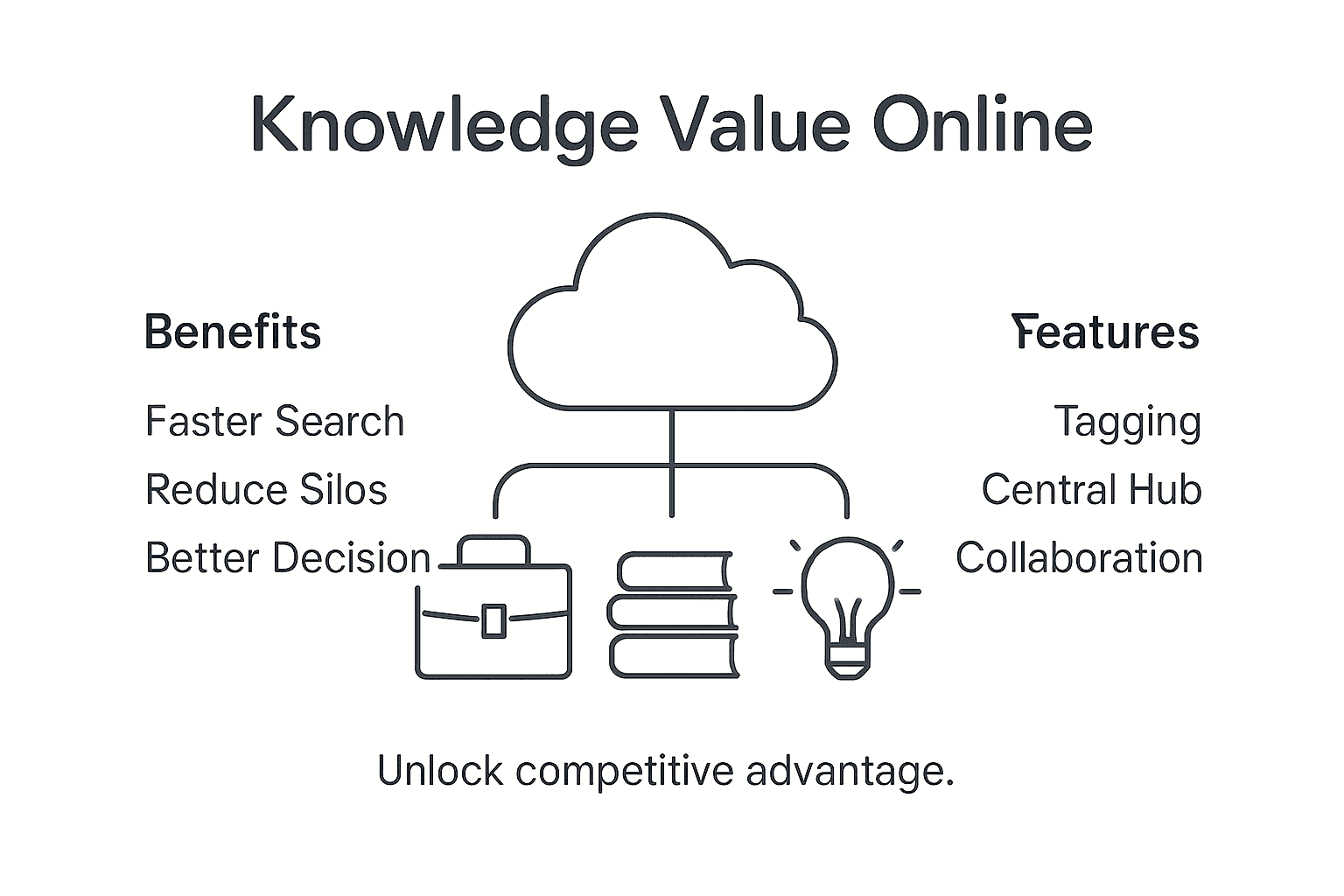
Organizations implementing robust knowledge management strategies gain significant competitive advantages. They can reduce redundant work, accelerate problem solving, preserve institutional memory, and create more agile, responsive operational environments. By treating knowledge as a strategic asset, companies can transform information from a static resource into a dynamic, living system that continuously generates value.
Pro tip: Develop a personal knowledge management workflow that categorizes and tags your resources systematically, making retrieval faster and more intuitive.
Types of Knowledge and Key Differences
Knowledge is a complex and multifaceted concept with various distinctive types that serve different organizational and personal purposes. Academic research identifies multiple knowledge categories that help professionals understand how information can be captured, processed, and applied across different contexts.

Knowledge types can be broadly classified into several fundamental categories, each serving a unique function in understanding and applying information:
Explicit Knowledge:
- Clearly documented and easily communicated
- Structured and formal
- Can be written down, shared digitally
- Examples: Manuals, standard operating procedures, reports
Tacit Knowledge:
- Personal, experience-based understanding
- Difficult to formalize or communicate
- Highly contextual and intuitive
- Examples: Professional instincts, cultural understanding
Procedural Knowledge:
- Focused on “how” something is done
- Involves skills and methodologies
- Gained through practical experience and training
- Examples: Technical skills, operational processes
Contextual Knowledge:
- Understanding the broader environment and circumstances
- Helps interpret information within specific scenarios
- Considers external factors and nuanced interpretations
- Examples: Market insights, cultural comprehension
Understanding these knowledge types enables organizations to develop more sophisticated knowledge management strategies. By recognizing how different knowledge types interact and complement each other, professionals can create more effective learning and information-sharing systems.
Here’s a summary of how different types of knowledge contribute to organizational success:
| Knowledge Type | Organizational Value | Typical Use Case |
|---|---|---|
| Explicit | Standardizes processes | Policy documentation |
| Tacit | Drives innovative solutions | Creative problem solving |
| Procedural | Improves operational efficiency | Technical training programs |
| Contextual | Enables market adaptability | Competitive analysis |
Pro tip: Create a personal knowledge mapping system that categorizes your information across different knowledge types, making it easier to retrieve and apply relevant insights when needed.
How Knowledge Management Systems Work
Knowledge management systems are sophisticated technological platforms designed to transform how organizations capture, store, and leverage intellectual assets. These specialized software solutions go far beyond simple document repositories, creating intelligent ecosystems that enable seamless information sharing and collaborative learning.
The APQC Knowledge Flow Process Framework outlines a comprehensive seven-step cycle that demonstrates how knowledge dynamically moves through organizational environments:
- Knowledge Creation: Generating new insights and information
- Knowledge Identification: Recognizing valuable intellectual assets
- Knowledge Collection: Systematically gathering and organizing information
- Knowledge Review: Validating and assessing collected knowledge
- Knowledge Sharing: Distributing information across teams and departments
- Knowledge Access: Ensuring easy retrieval and availability
- Knowledge Application: Implementing insights to drive organizational performance
Modern knowledge management systems typically incorporate several key technological features:
- Advanced search and retrieval capabilities
- Intelligent content classification
- User expertise mapping
- Collaborative annotation tools
- Automated knowledge recommendation engines
- Secure access controls
- Integration with existing organizational platforms
These systems are designed to break down traditional information silos, creating fluid, interconnected knowledge networks that adapt to changing organizational needs. By transforming static information into dynamic, accessible resources, knowledge management platforms enable teams to work smarter, reduce redundant work, and accelerate collective learning.
Compare key features of modern knowledge management systems and their business impact:
| System Feature | Description | Business Impact |
|---|---|---|
| Advanced Search | Finds relevant info rapidly | Saves time, increases productivity |
| Content Classification | Organizes resources automatically | Improves accuracy of retrieval |
| Expertise Mapping | Connects employees by skill | Enhances collaboration |
| Recommendation Engines | Suggests useful materials | Supports continuous learning |
Pro tip: Develop a personal tagging and categorization strategy within your knowledge management system to make information retrieval faster and more intuitive.
Benefits for Professionals and Creators
Knowledge management transforms how professionals and creators approach their intellectual work, offering unprecedented opportunities for growth and efficiency. By enabling systematic knowledge capture and sharing, individuals can dramatically accelerate their personal and professional development strategies.
Professionals benefit from knowledge management through multiple strategic advantages, including:
Individual Performance Enhancements:
- Faster problem-solving capabilities
- Reduced time spent searching for information
- Improved decision-making accuracy
- Enhanced learning and skill development
- Streamlined workflow processes
Collaborative Advantages:
- Breaking down organizational information silos
- Facilitating cross-team knowledge exchange
- Creating opportunities for interdisciplinary insights
- Supporting remote and distributed work environments
- Promoting a culture of continuous learning
Innovation and Creativity Boosters:
- Exposing professionals to diverse perspectives
- Enabling rapid knowledge transfer
- Supporting creative recombination of ideas
- Reducing redundant work efforts
- Accelerating intellectual property generation
For creators, knowledge management systems represent more than just organizational tools. They become dynamic platforms for intellectual exploration, allowing professionals to connect disparate ideas, track their own learning journey, and build comprehensive personal knowledge ecosystems that grow and evolve with their expertise.
Pro tip: Create a personal knowledge repository that goes beyond simple bookmarking, focusing on adding context, personal insights, and connections between different pieces of information.
Risks, Challenges, and Common Pitfalls
Knowledge management represents a complex undertaking fraught with significant organizational and human challenges. Research reveals substantial implementation gaps between recognizing knowledge management’s importance and effectively executing strategies, highlighting the nuanced nature of these systems.
Primary Risk Categories:
Organizational Barriers:
- Cultural resistance to knowledge sharing
- Lack of clear implementation guidelines
- Insufficient leadership support
- Limited understanding of knowledge management benefits
- Inadequate technological infrastructure
Human Behavioral Challenges:
- Personal information hoarding tendencies
- Fear of knowledge devaluation
- Lack of incentive structures
- Communication skill limitations
- Trust and collaboration deficits
Technical Implementation Risks:
- Poorly designed information taxonomy
- Weak search and retrieval mechanisms
- Security and access control complexities
- Data quality and consistency issues
- Integration challenges with existing systems
Organizational culture plays a critical role in knowledge management success. Attempting direct cultural transformation often fails, suggesting that knowledge sharing itself must be the catalyst for cultural evolution. Successful implementations focus on creating environments that naturally encourage information exchange and collaborative learning.
Understanding these challenges allows professionals to develop more strategic, nuanced approaches to knowledge management. By anticipating potential obstacles and designing flexible, human-centered systems, organizations can mitigate risks and create more adaptive knowledge ecosystems.
Pro tip: Conduct periodic knowledge management audits to identify cultural barriers, technological gaps, and opportunities for incremental improvement in your information sharing processes.
Unlock Your Personal Knowledge with Ease Using MemoKee
The article highlights the challenge of managing vast amounts of diverse knowledge and transforming it into a searchable, actionable resource. If you find yourself overwhelmed by scattered bookmarks, notes, links, and media, this creates a common pain point many professionals face: the frustration of “where did I save that?” MemoKee is designed to solve exactly this challenge by creating a centralized “save-and-find” hub that captures everything important to you—from articles and videos to tools and ideas—and makes it instantly retrievable.

Start building your personal knowledge ecosystem today with MemoKee. It helps you systematically organize and tag your saved content, turning raw information into a dynamic, searchable library. Whether you are a professional seeking faster problem-solving, a creator aiming to enhance innovation, or simply someone eager to reduce information overload, MemoKee empowers you to take control of your valuable knowledge assets. Discover how MemoKee can transform your organizational methods by visiting MemoKee now and never lose track of what matters again.
Frequently Asked Questions
What is knowledge management?
Knowledge management is a strategic approach that helps organizations capture, organize, and leverage their collective expertise, transforming raw information into actionable intelligence for improved decision-making.
What are the main types of knowledge in organizations?
The main types of knowledge are explicit, tacit, procedural, and contextual knowledge. Each type serves a unique function in understanding and applying information effectively within an organization.
How do knowledge management systems work?
Knowledge management systems are technological platforms designed to capture, store, and leverage intellectual assets, facilitating knowledge creation, sharing, access, and application across organizations.
What are the benefits of implementing knowledge management?
Implementing knowledge management can enhance individual performance, facilitate collaboration, boost innovation and creativity, and streamline workflow processes, ultimately leading to improved organizational effectiveness.